Leprosy and identity in the Middle Ages by Elma Brenner and François-Olivier Touati
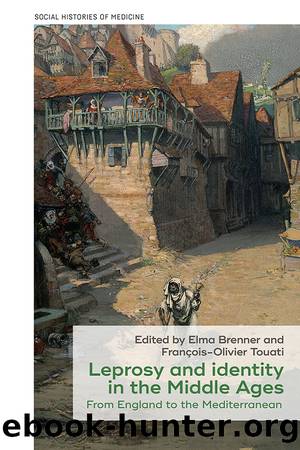
Author:Elma Brenner and François-Olivier Touati
Language: eng
Format: epub
Publisher: Manchester University Press
This request offers a glimpse at a perception of the practice of medicine as simultaneously professional and charitable, qualities that have been too often represented as competing with each other in the late medieval care of the sick.71 The language of the examiners, as well as that of their supplicants, was attuned to the emotional and social experience of disease, in addition to its medical manifestations.
Conclusion
Taken together, prescriptive hospital statutes, records concerning hospital practice and Lepraschau letters reveal diverse responses to lepers and leprosy in the late medieval Rhineland. Moreover, the social effects of a diagnosis of leprosy were variable. As revealed by hospital documents, those identified as leprous continued to be connected to their neighbours, friends and family members, in ways not solely determined by their diagnosis. The location and social function of leprosaria were determined not primarily by attitudes towards the disease, but by hospitalsâ status as religious institutions. This religious status was shared by the hospitalsâ residents, both healthy and sick. The agency of the leprous themselves is revealed in the fact that they might seek to live in informal communities, without the privileges of religious status, but also without its restrictions. Lepers within hospitals were most commonly known as good people (guden leuden), while those in less permanent groupings appear often as the poor children of God. It is the latter who seem to have been the group most distinctively defined as lepers, without the legal privileges of religious status, not necessarily having obtained any formal diagnosis, and primarily dependent on alms. They might also appear as the âarmen siechen ausgesetztâ, the poor sick set apart. As both hospital rules and Lepraschau letters reveal, however, such âsetting apartâ could be narrowly defined and even customised, limiting certain types of social interaction, but not enforcing full segregation. The lepers of the Rhineland appear not only in groups, but as individuals â seeking or disputing medical diagnosis, receiving gifts or receiving care, wandering about or doing their shopping â good people, poor sick, and active participants in late medieval communities.
Download
This site does not store any files on its server. We only index and link to content provided by other sites. Please contact the content providers to delete copyright contents if any and email us, we'll remove relevant links or contents immediately.
| Africa | Americas |
| Arctic & Antarctica | Asia |
| Australia & Oceania | Europe |
| Middle East | Russia |
| United States | World |
| Ancient Civilizations | Military |
| Historical Study & Educational Resources |
Room 212 by Kate Stewart(5206)
The Crown by Robert Lacey(4880)
Endurance: Shackleton's Incredible Voyage by Alfred Lansing(4864)
The Iron Duke by The Iron Duke(4421)
The Rape of Nanking by Iris Chang(4276)
Joan of Arc by Mary Gordon(4172)
Killing England by Bill O'Reilly(4065)
Say Nothing by Patrick Radden Keefe(4063)
I'll Give You the Sun by Jandy Nelson(3517)
Shadow of Night by Deborah Harkness(3433)
Hitler's Monsters by Eric Kurlander(3412)
Eleanor & Park by Rainbow Rowell(3272)
Blood and Sand by Alex Von Tunzelmann(3259)
Mary, Queen of Scots, and the Murder of Lord Darnley by Alison Weir(3257)
Darkest Hour by Anthony McCarten(3187)
Margaret Thatcher: The Autobiography by Thatcher Margaret(3133)
Book of Life by Deborah Harkness(2997)
Red Famine: Stalin's War on Ukraine by Anne Applebaum(2979)
The One Memory of Flora Banks by Emily Barr(2912)
